













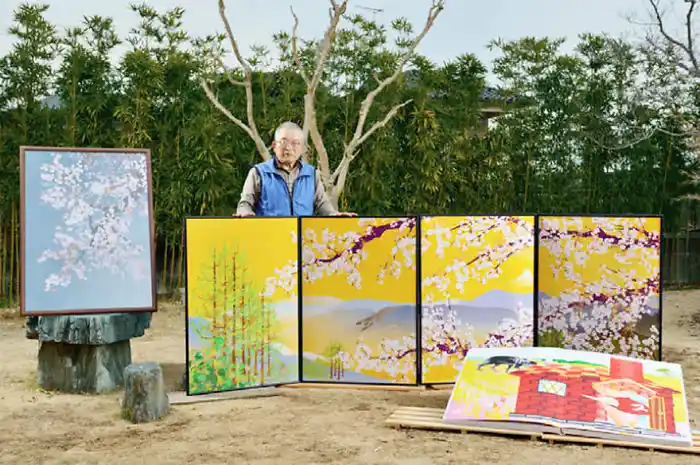
In a world dominated by sophisticated digital art tools like Photoshop and Procreate, one unlikely artist has captured global attention by creating breathtaking masterpieces using… Microsoft Excel. Meet Tatsuo Horiuchi, a retired Japanese gentleman whose intricate paintings of traditional Japanese landscapes have earned him the nickname “The Michelangelo of Microsoft Excel.”
Horiuchi’s story is one of ingenuity, persistence, and late-blooming creativity. Now in his 80s, he has been honing this unique art form for over two decades, proving that age is no barrier to innovation and that beauty can emerge from the most unexpected places—like a humble spreadsheet program.
From Retirement to Artistic Discovery
Tatsuo Horiuchi retired around the year 2000 after a career in engineering and medical equipment supply. Approaching retirement, he sought a new hobby to fill his time. Painting had always appealed to him, but traditional art supplies like canvases, brushes, and paints seemed expensive. Digital options? Professional graphics software was even pricier.
Instead, Horiuchi turned to something already installed on his computer: Microsoft Excel. “Graphics software is expensive, but Excel comes pre-installed on most PCs,” he explained in interviews. He even preferred it over free tools like Microsoft Paint, noting that Excel “has more functions and is easier to use.”
What started as an experiment quickly became a passion. Horiuchi set a 10-year plan for himself, dedicating the first few years to practicing basic shapes—vegetables, plants, and everyday objects—to master the tools.
Mastering the Unconventional Canvas
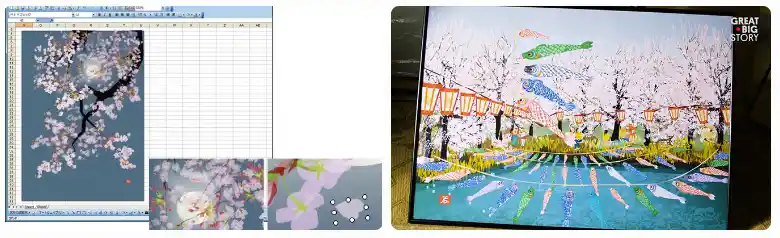
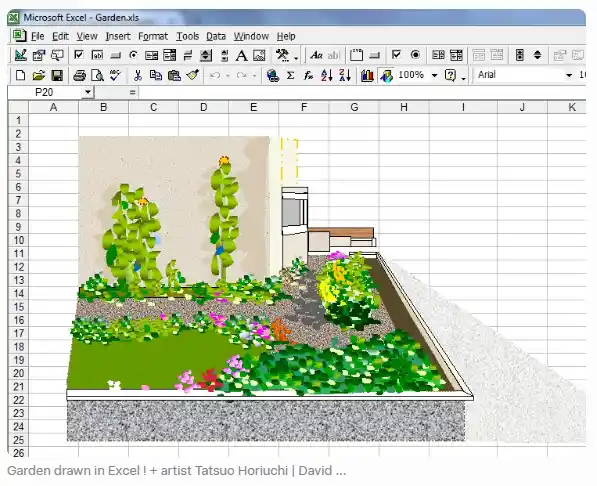
Excel isn’t designed for art. It’s a spreadsheet tool meant for data, charts, and formulas. But Horiuchi saw potential in its AutoShapes feature—simple vector tools for drawing lines, curves, circles, and polygons. By layering thousands of these shapes, adjusting colors, gradients, transparencies, and sizes, he builds complex scenes pixel by pixel (or rather, cell by cell).
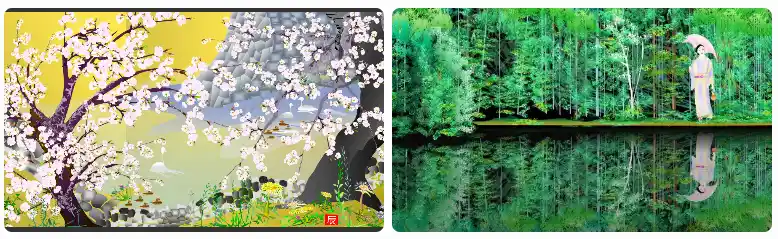
His works often depict serene Japanese nature: blooming cherry blossoms over ancient castles, cascading waterfalls like Kegon Falls, misty mountains, tranquil gardens, and snowy landscapes. The style evokes traditional ukiyo-e woodblock prints, with delicate details in flowers, water ripples, and foliage that fool the eye into thinking they’re traditional paintings.
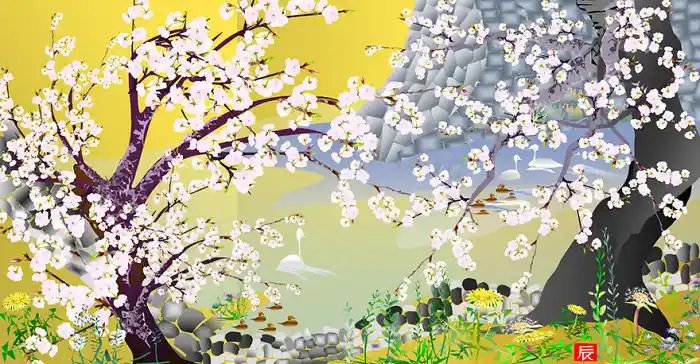
One iconic piece is “Cherry Blossoms at Historical Castle Site” (2006), a vibrant explosion of pink petals against a historic backdrop. Another favorite is his depiction of lush gardens or dramatic waterfalls, where he captures the flow of water using layered gradients and curves.
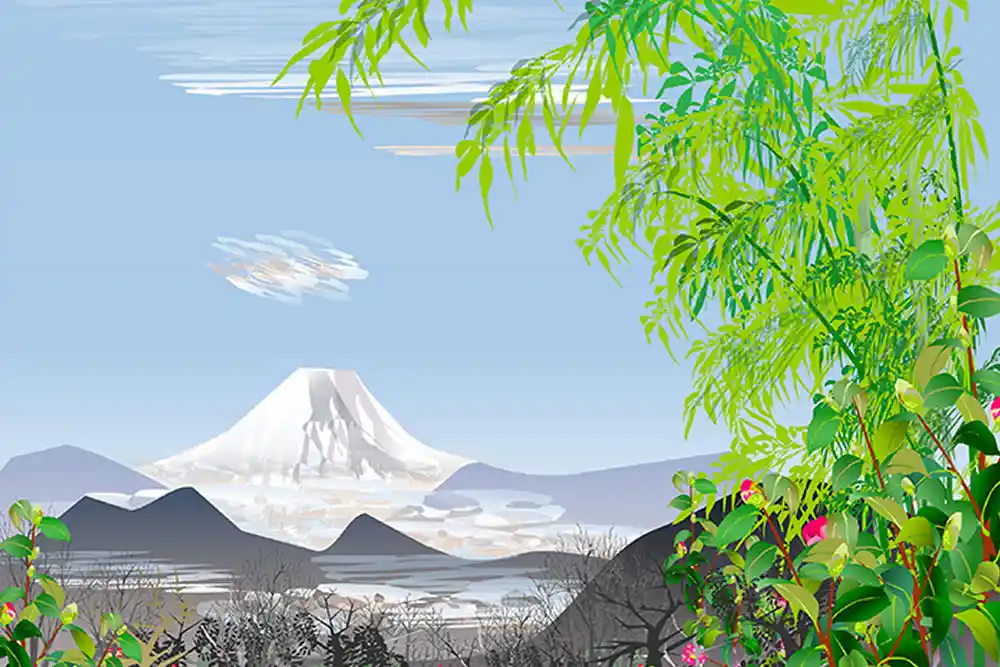
Horiuchi’s process is meticulous. He zooms in to fine-tune tiny details, stacking shapes to create depth and texture. Some pieces take weeks or months to complete, involving tens of thousands of individual elements.
Rise to Fame and Recognition
Horiuchi’s big break came in 2006 when he entered the Excel Autoshape Art Contest. His entry far surpassed others, winning first prize and stunning the judges. This victory brought initial attention in Japan.
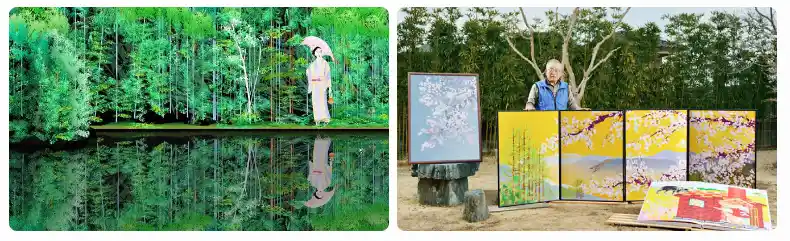
Word spread internationally in the 2010s through blogs like Spoon & Tamago and viral shares on Reddit and Bored Panda. A 2017 video by Great Big Story titled “The Michelangelo of Microsoft Excel” introduced him to millions, showing him at work in his home studio.
His art has been exhibited, and pieces acquired by the Gunma Museum of Art in Japan. He’s even sold prints via his website and inspired countless fans to experiment with Excel themselves.
Why Excel? The Philosophy Behind the Choice
Horiuchi’s choice of tool isn’t just about frugality—it’s philosophical. As a former engineer, he appreciates precision and modularity. “Even if you think you’re drawing a picture in the world of your senses, the contours are actually drawn with mathematical formulas,” he has said.
Excel allows endless undo, precise alignment, and scalability—advantages over physical media. It democratizes art: anyone with a computer can try it without buying supplies.
His story resonates in a digital age, reminding us that creativity thrives on constraints. Limitations force innovation.
Legacy of an Unlikely Master
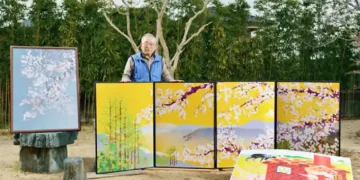
Today, Tatsuo Horiuchi continues creating from his home in Nagano Prefecture. His works celebrate Japan’s natural beauty while challenging perceptions of what “art tools” can be.
In an era of AI-generated images and high-end software, Horiuchi’s handmade Excel masterpieces stand out for their human touch and patience. He’s proof that it’s never too late to start something new, and that genius can bloom in the most ordinary places—like row 1000, column Z of a spreadsheet.
Horiuchi once said he never used Excel much at work but saw its potential in others’ graphs. Now, he’s turned a mundane office tool into a medium for timeless beauty. If this inspires you, fire up Excel and give it a try—who knows what masterpiece might be hiding in your cells?